Chinese polyester filament high-tenacity thread manufacturers are companies that specialize in producing exceptionally strong, durable, and consistent sewing threads primarily for industrial applications. These threads, Who are the Chinese Polyester Filament High-Tenacity Thread Manufacturers? defined by their high tensile strength (typically starting from 6.0 cN/dtex and exceeding 8.0 cN/dtex for premium grades), low elongation, and superior resistance to abrasion and chemicals, are critical components in sectors like automotive upholstery, luggage, footwear, safety gear, and technical textiles. China has established itself as a global hub for these products, with a manufacturing landscape ranging from large-scale, publicly-listed chemical fiber conglomerates to focused, technologically advanced specialty mills.
The Sourcing Guide: Chinese Manufacturers of High-Tenacity Polyester Filament Threads
Table of Contents
- Executive Summary: Navigating the World’s Leading Supply Base
- Part 1: Defining High-Tenacity Threads & Key Performance Metrics
- 1.1. The Technical Definition: Tenacity, Elongation, and Thermal Stability
- 1.2. Why Polyester Filament? Performance Advantages over Cotton, Nylon, and Spun Polyester
- 1.3. The Industrial Imperative: Applications Dictating the Need for High Tenacity
- Part 2: Mapping the Chinese Manufacturer Ecosystem
- 2.1. The Titans: Integrated Chemical Fiber Giants
- 2.2. The Specialists: Dedicated Industrial Thread Experts
- 2.3. Regional Clusters: Geographic Hotspots of Production
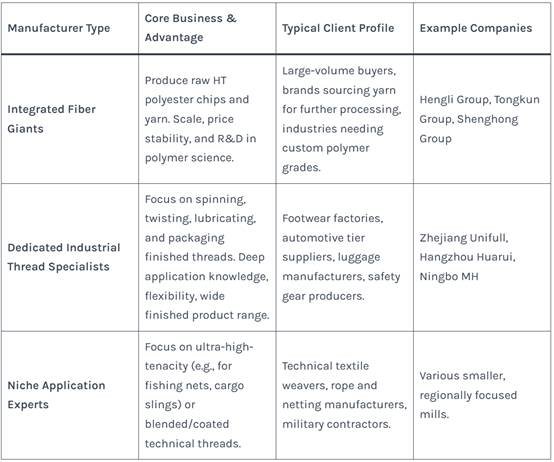
- Table 1: Classification of Chinese High-Tenacity Thread Manufacturers
- Part 3: In-Depth Analysis of Key Player Profiles
- 3.1. Jiangsu Hengli Chemical Fiber Co., Ltd.
- 3.2. Zhejiang Unifull Industrial Fibre Co., Ltd.
- 3.3. Hangzhou Huarui Industrial Co., Ltd.
- 3.4. Other Notable Manufacturers and Emerging Players
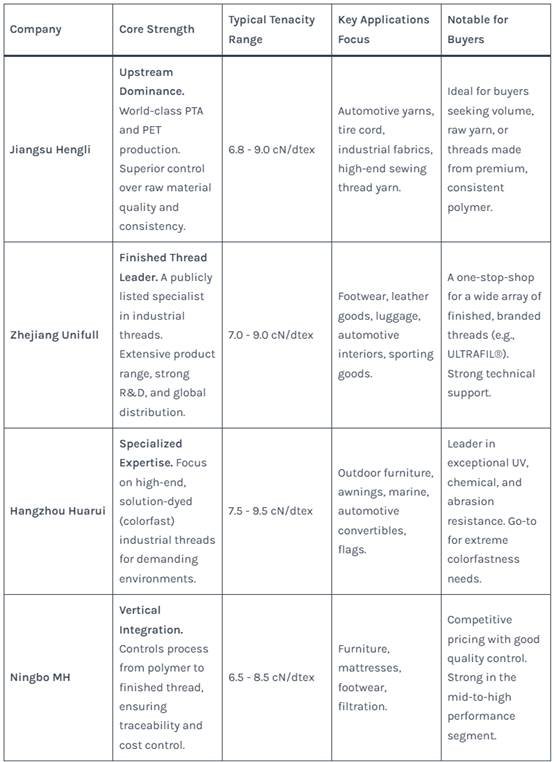
- Table 2: Comparative Profile of Leading Chinese Manufacturers
- Part 4: Critical Factors for Supplier Evaluation & Selection
- 4.1. Technical Capability: Polymer Control, Draw Ratio, and Heat-Setting
- 4.2. Product Portfolio: Denier Range, Filament Count, and Color Solutions
- 4.3. Quality Systems & Certifications: ISO, OEKO-TEX, and Industry-Specific Approvals
- 4.4. Logistics & Supply Chain Reliability
- Part 5: Application-Specific Sourcing Guidance
- 5.1. Automotive Interiors: Demanding Abrasion Resistance and UV Stability
- 5.2. Footwear & Leather Goods: Need for High Tensile Strength and Seam Integrity
- 5.3. Filtration, Belting, and Safety Harnesses: Extreme Strength and Low Elongation
- 5.4. Luggage, Tents, and Outdoor Gear: Balancing Strength with Aesthetics
- Part 6: Navigating Challenges in Sourcing from China
- 6.1. Ensuring Consistent Quality Across Large Batches
- 6.2. Intellectual Property and Product Specification Confidentiality
- 6.3. Communication, Lead Times, and Incoterms Clarity
- Part 7: The Future of High-Tenacity Threads: Trends & Innovations
- 7.1. Sustainable and Recycled Polyester (rPET) High-Tenacity Threads
- 7.2. Smart and Functional Threads (e.g., Conductive, Flame-Retardant)
- 7.3. Digitalization and Traceability in the Supply Chain
- Frequently Asked Questions (FAQ)
- Conclusion: Building a Resilient and High-Performance Supply Chain
1. Executive Summary: Navigating the World’s Leading Supply Base
For global procurement managers in technical textiles, automotive, and durable goods, China is not merely an option but a strategic necessity for sourcing high-tenacity polyester filament threads. The country’s unparalleled scale, vertical integration from PTA to finished thread, and relentless drive for technological advancement offer a combination of cost efficiency, consistent quality, and specialized product development that is difficult to match globally. However, the market is not monolithic. Success depends on understanding the distinct segments within the manufacturer landscape—from the colossal chemical fiber producers to the nimble industrial thread specialists. This guide provides a detailed roadmap to identify, evaluate, and partner with the right Chinese manufacturers to secure the high-performance threads that form the backbone of your most demanding products.
2. Part 1: Defining High-Tenacity Threads
- Technical Definition: High-tenacity (HT) polyester threads are engineered for maximum strength and minimal stretch. Key metrics include:
- Tenacity: >6.0 grams per denier (g/d) or >6.6 cN/dtex is standard. Premium threads exceed 8.0 g/d (8.8 cN/dtex).
- Elongation at Break: Typically between 10% and 18%, much lower than regular textile polyester (~25-35%), ensuring seam stability.
- Thermal Shrinkage: Controlled to be very low (<2%) to prevent seam puckering.
- Advantages: Compared to nylon, HT polyester offers superior UV and chemical resistance. Compared to spun polyester, filament provides higher strength and consistency with less lint.
3. Part 2: Mapping the Chinese Manufacturer Ecosystem
China’s manufacturing base is structured to cater to different buyer needs.
Table 1: Classification of Chinese High-Tenacity Thread Manufacturers
Regional Clusters:
- Zhejiang & Jiangsu Provinces: The heartland, hosting giants like GLYarn and countless specialized mills in cities like Shaoxing and Hangzhou.
- Fujian Province: A major hub for downstream applications like footwear and bags, supporting a strong thread industry.
4. Part 3: In-Depth Analysis of Key Player Profiles
Table 2: Comparative Profile of Leading Chinese Manufacturers
5. Part 4: Critical Factors for Supplier Evaluation
- Technical Capability: Ask about their draw ratio process and heat-setting technology, which directly determine tenacity and shrinkage.
- Quality Systems: Require ISO 9001 certification as a baseline. For automotive, IATF 16949 is a strong signal. OEKO-TEX Standard 100 is crucial for consumer goods.
- Product Portfolio: Ensure they offer the denier (e.g., 120D, 150D, 300D, 1000D) and filament counts appropriate for your sewing machines and fabric weight.
6. Part 5: Application-Specific Sourcing Guidance
- Automotive: Prioritize manufacturers with IATF 16949 certification. Threads must withstand UV exposure, temperature cycling, and abrasion against foam and plastics. Solution-dyed threads from specialists like Huarui are often specified.
- Footwear: Need exceptional abrasion resistance (to survive needle heat) and consistent lubrication for high-speed stitching. Partners like Unifull have dedicated footwear labs.
- Safety Gear (Harnesses, Slings): Non-negotiable focus on minimum breaking strength (MBS) certification and exceptionally low elongation. Rigorous third-party testing is a must.
7. Part 6: Navigating Sourcing Challenges
- Quality Consistency: Implement a strict Acceptable Quality Level (AQL) inspection upon receipt. Partner with manufacturers that use statistical process control (SPC).
- IP Protection: Sign robust NDAs and consider splitting your custom thread specification across two non-competing suppliers.
- Communication: Insist on detailed Technical Data Sheets (TDS) for every product. Clarify all Incoterms (e.g., FOB Shanghai, CIF Los Angeles) to avoid hidden logistics costs.
8. Part 7: Future Trends & Innovations
- rPET Threads: Leading manufacturers are developing high-tenacity threads from 100% recycled PET, meeting the same strength standards with a reduced carbon footprint. This is a key ask from EU and North American brands.
- Functionalization: Threads with built-in flame retardancy, conductivity for wearable tech, or antimicrobial properties are emerging from R&D labs.
- Digital Traceability: QR codes on cones linking to batch-specific test data (tenacity, shrinkage) will become a standard expectation for quality assurance.
9. Frequently Asked Questions (FAQ)
Q1: What is the realistic minimum order quantity (MOQ) for a custom high-tenacity thread from China?
A1: It varies dramatically by supplier type. For a standard color/denier from a thread specialist, MOQs can be as low as 500-1,000 cones. For a fully custom polymer recipe or color from an integrated giant, the MOQ may start at 5-10 tons. Always discuss MOQ upfront.
Q2: How does the cost of Chinese high-tenacity thread compare to European or American equivalents?
**A2: Chinese threads typically offer a **significant cost advantage of 20-40%, depending on the grade and volume. This stems from lower labor costs, vertical integration, and economies of scale. However, the total cost of ownership must include rigorous quality control, shipping, and import duties.
Q3: Can Chinese manufacturers produce threads compliant with specific international standards (e.g., DIN, ASTM)?
A3: Absolutely. Reputable manufacturers routinely produce threads to meet DIN 6000, ASTM D204, and other international standards. You must explicitly state the required standard and test methods in your purchase order and request certified test reports from accredited labs.
Q4: What is “solution-dyed” thread, and why is it important for outdoor applications?
**A4: Solution-dyed (or dope-dyed) thread has pigment added to the polymer melt before extrusion. Unlike conventionally dyed thread, its color is *locked into the fiber*, offering **exceptional UV resistance, colorfastness, and resistance to chlorine, bleach, and chemicals. It is essential for automotive interiors, outdoor furniture, and marine applications.
Q5: We need a thread for heavy-duty leather sewing. What denier and tenacity should we look for?
**A5: For heavy leather (e.g., saddlery, work boots), a core-spun thread (polyester core with a spun outer wrap) is often best. If using pure filament, look for *Tex 40 – Tex 80 (approx. 350D – 700D)* with a minimum tenacity of 8.0 g/d. Consult the manufacturer’s technical team for needle and tension recommendations.**
Q6: How do we verify a supplier’s claimed tenacity values?
**A6: Do not rely solely on their datasheet. Implement a **third-party inspection protocol. Randomly select cones from a production lot and send samples to an international testing lab (e.g., SGS, Bureau Veritas) in your country or a neutral third country for independent tensile testing per ASTM D2256.
Q7: Are there reliable B2B platforms to discover and vet these manufacturers?
**A7: While platforms like Alibaba.com host many suppliers, they are not ideal for complex industrial products. For high-tenacity threads, it is better to **identify key players from industry directories, visit major trade shows like ITMA or ShanghaiTex, and then initiate direct contact. Cross-reference with their official websites and certifications.
10. Building a Resilient Supply Chain
Sourcing high-tenacity polyester thread from China is a strategic endeavor that balances significant cost and capability advantages with the need for diligent partner management. By moving beyond a simplistic price-focused approach to a technical partnership model, you can unlock world-class quality and innovation. The key is to meticulously map your application requirements to the specific strengths of different manufacturer types, establish clear and verifiable quality gates, and foster transparent communication. In doing so, you secure not just a commodity, but a critical component that ensures the durability, safety, and integrity of your products in the global marketplace.

More Stories
What Is BLIK and How Does It Simplify Digital Payments?
Key Factors to Consider When Buying Used Howo371 Dump Trucks
Tips and Insights for Buying Reliable Used Howo Water Trucks for SaleA Guide to Finding Quality Used Howo Water Trucks for Sale