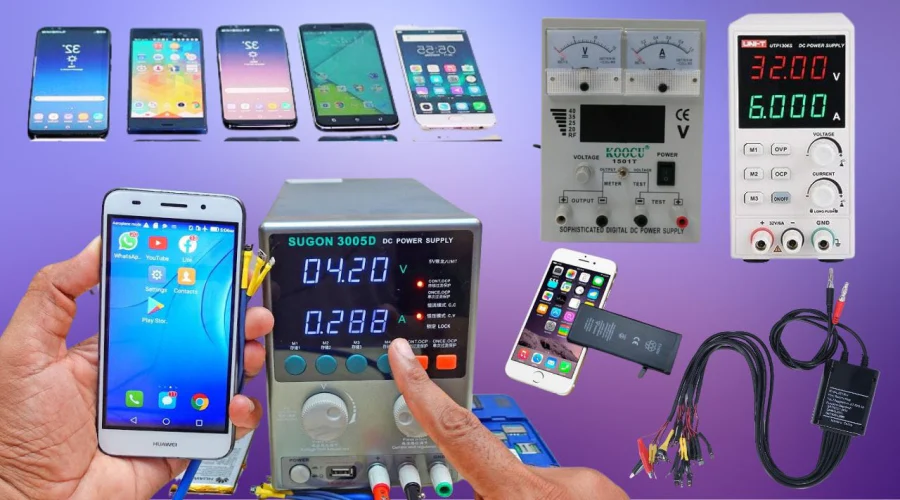
In professional phone repair, the multimeter is the scout, but the mobile repair DC power supply is the surgeon. Far more than just a battery substitute, this benchtop tool is an indispensable diagnostic powerhouse, allowing technicians to power, test, and analyze a smartphone’s motherboard with surgical precision and complete control. For tackling complex power-related issues, from mysterious shutdowns to catastrophic short circuits, it is the definitive diagnostic tool.
At its core, a dedicated phone repair power supply provides clean, adjustable, and measurable DC voltage. Instead of connecting a volatile or dead battery, the technician directly connects the supply’s leads to the phone’s battery connector pads on the logic board. This simple act unlocks a world of insight. The key feature is the current readout (measured in Amps or milliamps). By observing the “amp draw,” a technician can see exactly how much current the motherboard consumes in real-time.
This is where true diagnosis begins. A known-good motherboard will draw a specific, small amount of current in a “sleep” state and then show a clean, controlled spike when triggered to power on. Abnormal readings tell a clear story:
- Zero Current (0.00A): The board is not drawing any power, indicating a break in the power line—a possible burnt fuse, cracked trace, or damaged power IC.
- Excessive Current (Short Circuit): The amp meter will spike to its maximum, often accompanied by the power supply’s “Constant Current” (CC) mode light activating. This instantly confirms a direct short to ground on the main power line, often caused by a faulty capacitor or damaged chip.
- Unstable or Fluctuating Current: This points to a failing power management IC or other component that is intermittently failing under load, causing the random reboots and shutdowns that plague many devices.
Using a DC power supply for mobile repair allows for safe testing. The voltage can be set to the exact specification (typically 3.8V – 4.2V for modern phones), and current limits can be set to protect the board from damage during testing. Furthermore, the “psu jerk” technique—briefly touching the leads to the connector—can safely detect a short without applying sustained power that could burn components.
For any repair shop moving beyond simple screen swaps, this tool is non-negotiable. It transforms guesswork into data-driven diagnosis, saving hours of futile probing and enabling accurate, component-level repairs on the most challenging power-related faults.




More Stories
Why isCalculator Finance Tools Are Essential Alongside Free Online Calculators
Effortless HEIC to PNG Conversion: Fast Solutions That Work Across All Devices
Fast and Reliable AI Detector Solutions for Advanced Content Analysis