Introduction
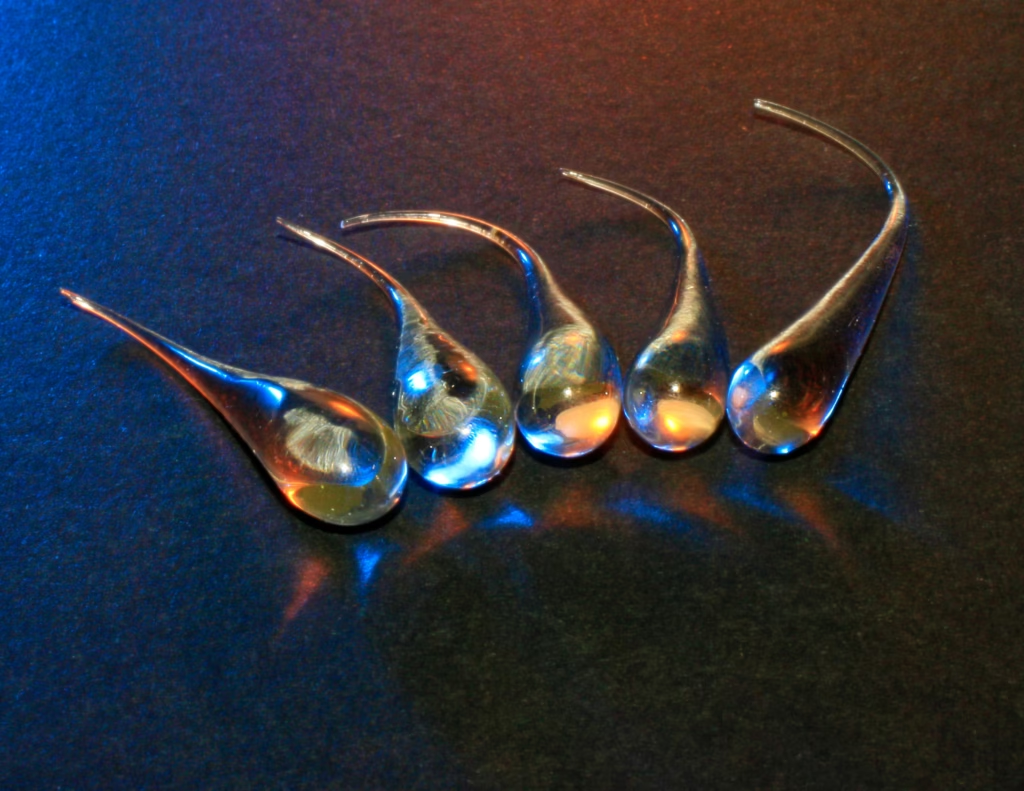
A prince rupert’s drop exploding is one of the most fascinating demonstrations of how stress and structural forces can remain hidden inside glass. At first glance, a Prince Rupert’s Drop looks like a simple teardrop-shaped piece of hardened glass. Its rounded head can withstand surprisingly strong impacts, yet a tiny weakness in its thin tail can cause the entire object to break apart almost instantly. This dramatic behavior makes the Prince Rupert’s Drop an excellent example of how internal stresses influence the strength and failure of materials.
The phenomenon has attracted attention from scientists, engineers, educators, and curious observers because it challenges the ordinary assumption that fragile glass should break easily. Understanding why the drop can survive a powerful blow but suddenly disintegrate after its tail is damaged requires a closer look at its manufacturing process, internal stress distribution, fracture mechanics, and the rapid movement of cracks through glass.
What Is a Prince Rupert’s Drop?
A Prince Rupert’s Drop is created by allowing molten glass to fall into a container of cold water. The outside surface of the molten glass cools and solidifies extremely quickly, while the interior remains hot for longer. As the remaining hot glass gradually cools, it contracts inside the already hardened outer layer.
This unusual cooling process creates a special pattern of residual stress. The surface becomes highly compressed, while the interior experiences significant tensile stress. The result is a glass object with an exceptionally strong outer layer but a vulnerable internal structure.
The shape of the drop is also important. It typically has a large, rounded head connected to a long, narrow tail. The rounded portion can resist substantial external forces because cracks have difficulty penetrating its compressed surface. The thin tail, however, provides a pathway through which a fracture can enter the stressed interior.
Why Does the Drop Become So Strong?
The strength of the drop comes largely from compressive stress at its surface. Glass is particularly resistant to cracks when its surface is under compression. A crack normally grows when tensile forces pull its surfaces apart, but compressive forces can suppress the opening of surface cracks.
This principle is used in other types of strengthened glass as well. Tempered glass, for example, is manufactured to create compressive stresses near its surface, making it stronger against many forms of impact.
In a Prince Rupert’s Drop, the cooling process naturally produces a similar type of stress arrangement. The outer layer is compressed while the interior contains stored elastic energy. Although the drop may appear completely solid and stable, it is effectively holding a large amount of mechanical energy within its structure.
That stored energy is one of the main reasons the eventual break can be so dramatic.
What Causes a Prince Rupert’s Drop to Explode?
The key to a prince rupert’s drop exploding is damage to the tail. The tail is much more vulnerable than the rounded head. If the tail is scratched, snapped, or struck in the right way, a crack can enter the interior of the drop.
Once the crack reaches the tensile region inside the glass, the stored elastic energy becomes available to drive the fracture forward. Instead of stopping after producing a small break, the crack can accelerate through the structure.
The result is an extremely rapid failure that can make the drop appear to explode.
Importantly, the word “exploding” describes the dramatic appearance of the fracture rather than a chemical explosion. There is no explosive chemical reaction taking place. The energy comes from mechanical stresses that were created during cooling.
The Role of Internal Stress
Internal stress is central to understanding the behavior of these drops. During rapid cooling, different parts of the glass change temperature at different rates. The surface becomes rigid first, while the interior remains hot and capable of contracting.
As the interior eventually cools, it wants to shrink. However, the already-solid outer shell restricts that contraction. This produces a complex stress pattern throughout the drop.
The outer region is placed primarily under compression, while the interior is subjected to tension. This arrangement allows the surface to resist ordinary impacts while simultaneously storing energy that can contribute to catastrophic fracture if the internal stress balance is disturbed.
Scientists can study these stress patterns using optical techniques that reveal differences in how polarized light passes through the glass. Such observations help demonstrate that the drop’s remarkable behavior is directly connected to its manufacturing history.
How Fast Does the Crack Travel?
One of the most remarkable features of a Prince Rupert’s Drop is the speed of its fracture. Once the tail initiates a crack, the fracture can travel through the drop at very high speed.
The crack does not simply move slowly from one point to another. Instead, the stress field surrounding the advancing crack contributes to continued propagation. As the crack moves through the tensile interior, stored elastic energy is released and helps sustain the fracture.
The rounded head may therefore break into a large number of tiny pieces almost instantaneously. High-speed photography has been used to study similar rapid fracture processes and has helped researchers understand how cracks accelerate through stressed glass.
Why the Head Can Survive a Hammer Blow
One of the most impressive demonstrations involves striking the rounded head of the drop. Under suitable conditions, the head can withstand an impact that would normally shatter ordinary glass.
The explanation lies in the compressed surface layer. When the hammer hits the rounded head, the impact creates forces, but surface compression makes it difficult for cracks to open and penetrate.
The situation changes completely when the tail is damaged. A small fracture in the tail can reach the tensile interior, where the stress conditions strongly favor crack growth.
This contrast demonstrates an important engineering principle: material strength is not determined only by what a material is made from. Manufacturing processes, geometry, surface condition, and internal stresses can dramatically affect how a material behaves under load.
Fracture Mechanics Behind the Sudden Break
Fracture mechanics provides a useful framework for understanding the phenomenon. A crack grows when the conditions around its tip allow the applied or stored energy to overcome the resistance of the material.
In a Prince Rupert’s Drop, the residual stresses created during cooling provide a substantial source of energy. Once an appropriate crack enters the stressed region, the crack can continue growing rapidly.
The shape of the drop also influences how the stress field interacts with the crack. The narrow tail acts as a critical initiation point, while the larger head contains the compressed surface and tensile interior.
This combination of geometry and residual stress creates a material that behaves almost like two different structures at once: remarkably resistant to certain impacts but extremely vulnerable to a specific type of damage.
What Happens During the Final Failure?
When the critical crack reaches the interior, the failure process becomes extremely rapid. The crack can branch into multiple directions, producing countless small fragments.
The stored energy is released as the stressed structure loses its ability to remain intact. This is why watching a Prince Rupert’s Drop fail can be so surprising. There may be no obvious warning before the entire drop disintegrates.
The suddenness of the event is an important lesson in structural failure. A material can appear stable for a long period while containing significant stored energy. Once a critical flaw appears, the transition from stable to unstable behavior can happen extremely quickly.
Applications and Scientific Importance
Although Prince Rupert’s Drops are primarily known as scientific curiosities, they illustrate concepts that are important in engineering and materials science. Residual stress, thermal treatment, crack propagation, surface compression, and controlled fracture all have practical relevance.
Modern glass manufacturing uses carefully controlled thermal processes to create stronger products. Understanding how stresses develop inside glass can help engineers design windows, screens, laboratory equipment, automotive components, and other products that need improved resistance to impact.
The Prince Rupert’s Drop therefore serves as a simple but powerful demonstration of principles that extend far beyond a small piece of glass.
Conclusion
A prince rupert’s drop exploding is not the result of chemicals, combustion, or conventional explosive forces. Its spectacular destruction comes from mechanical energy stored within the glass during rapid cooling. The process creates a compressed outer surface and a stressed interior, giving the rounded head remarkable impact resistance while leaving the tail as a critical weakness.
When the tail is damaged, a crack can enter the tensile region and rapidly release the stored energy. The resulting fracture can travel through the drop at extraordinary speed, breaking the entire structure into tiny fragments.
The Prince Rupert’s Drop is therefore much more than an unusual glass object. It is a striking demonstration of how temperature, geometry, residual stress, and fracture mechanics can combine to produce a material that is exceptionally strong in one situation and astonishingly fragile in another.




More Stories
Common Traits Shared by High-Performing Sales Professionals and How to Develop Them
Warning Signs That Indicate You Need Top MacBook Repair and Services
New Construction Homes in Ave Maria: A Guide for Modern Homebuyers